











The Autonomous Supply Chain Is Emerging: Insights from BlueYonder ICON 2026

 “We’re in the intelligence revolution, and supply chain is where intelligence meets the physical world.” The real risk is not a lack of technology; it’s how that technology is applied. “The danger is that we bolt intelligence onto yesterday’s workflows instead of reimagining how supply chains should operate.” In this new paradigm, the transformation is not about optimizing individual users or functions. “The unit of transformation is the system and the outcomes it delivers.”
At BlueYonder ICON 2026, the conversation around supply chain transformation moved decisively beyond vision and into execution. While prior industry discussions focused on the urgent need to modernize fragmented systems, the tone this year was fundamentally different: the architecture, intelligence, and operating model required for the next generation of supply chains are no longer theoretical; they are beginning to take shape in real deployments. The shift underway is not incremental. It represents a transition from function-level optimization to real-time, AI-driven orchestration of the supply chain as a system.
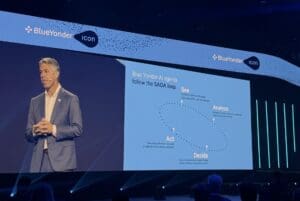
This evolution starts with a reframing of what the supply chain is. As highlighted by the BlueYonder, CEO Duncan Angove, during his opening keynote, supply chain is the domain where intelligence meets the physical world, where decisions are converted into movement, inventory, and customer outcomes. That positioning makes it central to the broader “intelligence revolution,” but it also exposes a key failure mode. Many organizations are attempting to layer AI on top of legacy processes rather than redesigning those processes entirely. The keynote’s roundabout analogy captures the risk: “introducing new technology without changing behavior eliminates most of the potential value.” The implication is clear; AI is not a technology shift alone; it is an operating model transformation.
What ICON 2026 makes clear is that this new operating model is centered on network orchestration. Traditional supply chains have been built as a collection of loosely connected systems, planning, warehouse management, transportation, and execution operating in silos, each locally optimized but globally inefficient. This fragmentation is a primary source of cost, latency, and risk. The emerging model replaces this structure with a coordinated system that leverages shared data, real-time visibility, and continuous decision-making across the network. Instead of optimizing nodes, organizations are beginning to optimize flows across the entire system, aligning decisions to enterprise-level outcomes rather than functional metrics.
The enabling layer for this shift is what BlueYonder defines as the cognitive supply chain platform. Built on a unified data model and cloud-native architecture, the platform eliminates the latency and integration challenges that have historically constrained supply chain performance. More importantly, it introduces the concept of unified decisioning, the ability to evaluate trade-offs across cost, service, inventory, and increasing sustainability, in real time. This is a significant departure from traditional planning cycles, where decisions are often made based on incomplete or outdated information. In the cognitive model, decisions are continuously recalibrated as conditions change, enabling a level of responsiveness that was previously unattainable.
However, the most transformative element of ICON 2026 is the maturation of agentic AI as the execution layer of the supply chain. Over the past year, the role of AI has evolved from recommendation engines to operational agents capable of acting directly within systems. These agents follow continuous loop sensing events, analyzing conditions, deciding on actions, and executing changes, allowing them to manage workflows across warehousing, transportation, and planning without constant human intervention. This marks a fundamental shift in how work is performed. The user is no longer the primary operator of systems; instead, the user becomes a supervisor of an intelligent, continuously optimizing network.
This shift is reinforced by the introduction of the BlueYonder Orchestrator, which acts as the coordination layer for these agents. Rather than a single AI model or application, the Orchestrator manages a system of agents, models, and workflows, enabling them to operate cohesively across the supply chain. It provides critical capabilities such as memory, governance, and orchestration logic, allowing agents to retain context, operate securely, and collaborate with each other in real time. The design is intentionally open and extensible, reflecting a broader industry trend toward “headless” architectures where systems are built to be consumed not just by humans, but by other intelligent systems.
An important nuance that emerged across sessions is that this new model requires a different approach to AI itself. Supply chain environments demand high precision, low latency, and cost-efficient execution characteristics that generic AI models are not optimized for. As a result, organizations are moving toward specialized, domain-trained models that operate alongside larger, general-purpose models. These specialized models are designed to handle specific operational tasks, such as warehouse decision-making or transportation optimization, with a level of efficiency and accuracy that makes large-scale deployment viable. This layered approach to intelligence, combining broad reasoning with domain precision, represents the emergence of supply chain AI as a distinct category.
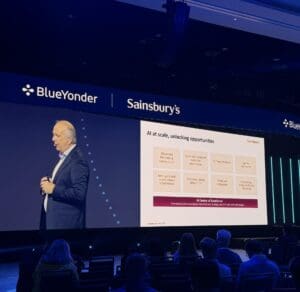 The practical impact of these changes is best illustrated through the keynote customer examples. “Availability is becoming a strategic driver. Reliability is becoming a primary competitive edge, not just an operational measure,” Simon Roberts, CEO of Sainsbury’s. Simon delivered a speech on how supply chain capabilities are directly tied to competitive differentiation in retail. By investing in AI, platform integration, and operational transformation, the company has driven product availability to approximately 98% across its network while simultaneously improving customer satisfaction and market share. “When customers choose us, they are choosing the systems behind the scenes. They must be even more dependable.” This highlights a critical shift: availability and reliability are no longer operational metrics; they are core drivers of customer experience and brand trust. In highly competitive markets, the ability to consistently deliver to customer expectations is becoming a defining advantage.
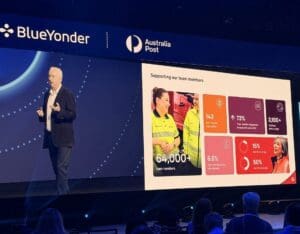
Paul Graham, the CEO of Australia Post, offered a different but equally important perspective, highlighting the complexity of transforming large-scale, legacy logistics networks. Operating thousands of facilities and managing millions of daily deliveries, the organization described its historical challenge as lacking a “central brain” to coordinate operations. The deployment of modern transportation management systems and AI-driven coordination is effectively creating that brain, enabling real-time decision-making across its vast network. “The movement of data is now more critical than the physical movement of the product.” What makes this case particularly compelling is the scale of transformation required, not just in technology, but in processes, culture, and workforce capabilities. It underscores that the journey to an intelligent supply chain is as much about organizational change as it is about system implementation.
 Beyond planning and execution, AI-driven orchestration is also expanding into areas that were previously treated as secondary. Returns, for example, are being reframed as a strategic data asset. “Returns data is incredibly valuable, it tells you what’s broken and what to fix upstream.” Rather than simply processing returned goods, organizations are using returns data to identify product quality issues, refine demand planning, and optimize recommerce strategies. Similarly, sustainability is being embedded directly into operational decision-making. Instead of reporting emissions after the fact, organizations can now model and optimize trade-offs between cost, and carbon impact in real time, making sustainability a core dimension of supply chain performance rather than a compliance requirement.
Another major theme at ICON 2026 is the acceleration of time-to-value through what is being described as frictionless outcomes. By leveraging AI agents to automate the software lifecycles, such as data migration, configuration, and testing, organizations are dramatically reducing the time and effort required to deploy complex systems. Early use cases demonstrate significant reductions in implementation timelines, effectively transforming deployments from multi-month projects into rapidly scalable capabilities. This is a critical enabler of transformation, as it removes one of the primary barriers to adopting new supply chain technologies on scale.
Taken together, these developments point to the emergence of the autonomous supply chain. In this model, intelligent agents continuously monitor the network, evaluate trade-offs, and execute decisions across all layers of planning and execution, while humans focus on strategy, oversight, and exception management. The supply chain evolves from a collection of systems into a coordinated, adaptive network capable of responding to disruption and opportunity in real time.
The shift from ICON 2025 to ICON 2026 reflects a rapid progression from recognizing the need for transformation to operationalizing a new paradigm built on orchestration, agentic AI, and unified systems. The path forward is no longer ambiguous. Organizations that embrace this model will move toward fully autonomous, self-optimizing supply chains. Those that remain anchored to fragmented architectures and manual coordination will find themselves increasingly constrained in a world that now operates at machine speed.
AI Is Reshaping Supply Chain Execution. Here’s What Comes Next.
Two ARC Advisory Group white papers on the next stage of AI in supply chain operations.
AI is moving beyond isolated copilots and technical architecture into coordinated operational decision systems. This ARC Advisory Group white paper explains how supply chain AI is shifting from capability to execution, where context, governance, workflows, thresholds, and action pathways determine whether AI improves real decisions across planning, logistics, sourcing, fulfillment, and risk management.
Download Our Featured White Paper:
AI in the Supply Chain Part II: From Architecture to Execution - Defining the Decision Intelligence Layer in Modern Supply Chain
Download Our Foundational White Paper:
AI in the Supply Chain: Architecting the Future of Logistics with A2A, MCP, and Graph-Enhanced Reasoning
Explore Our Domains
Planning, Execution & Visibility | Transportation & Logistics Operations | Warehousing, Fulfillment & Automation | Global Trade & Compliance | AI & Advanced Analytics | Data, Integration & Interoperability | Supply Chain Platforms | Risk & Resilience | Sustainability & ESG
Independent ARC research for supply chain leaders and technology decision-makers.