














Weekly Supply Chain and Logsitics News Round Up (June 15th-18th 2026)

This week in logistics, the industry faces a pivotal shift as Transportation Management Systems evolve into ‘decision intelligence’ hubs, moving beyond basic routing to become the core operating brain of the supply chain. Meanwhile, operational complexity reaches new heights with the massive logistical undertaking of the 2026 FIFA World Cup, even as trade tensions show signs of cooling following the European Parliament’s approval of a landmark EU-US tariff relief deal. From record-breaking automation at Nestlé’s new California hub to the fluctuating volatility of global air freight rates, these developments underscore a sector increasingly defined by high-tech integration and rapid adaptation to global market forces.
The Leading Supply Chain and Logistics Stories of the Week:
TMS Is Becoming Less of a Routing Tool and More of a Decision Intelligence Layer Beyond Execution
 The role of the Transportation Management System (TMS) is undergoing a major paradigm shift. While traditional evaluations still focus heavily on execution-level metrics—like route optimization, automated tendering, and freight audit capabilities—these features have essentially become table stakes. Moving forward, the true strategic value of a TMS lies in its evolution from execution software to “transportation decision infrastructure.” Rather than just completing transactions, next-generation platforms serve as the continuous decision-making layer of the supply chain. By drawing data from across the entire network, integrating external market signals, and resolving multi-functional bottlenecks, modern TMS solutions are transitioning into the core operating brain that synchronizes movement, cost, and service levels in real time.
The Logistics Issue: The Supply Chains Behind the World Cup
 While most fans focus entirely on the action on the pitch, supply chain professionals are watching what might be the most complex logistical undertaking in sporting history: the 2026 FIFA World Cup. Spanning three host nations—the United States, Canada, and Mexico—the sheer scale of the tournament requires moving more than twenty million pounds of equipment, coordinated across 5,000 vehicles and millions of square feet of warehouse space. The challenge isn’t just massive volume; it’s the absolute lack of tolerance for delay or error across highly regulated international borders. Industry experts point out that success hinges on establishing a unified ecosystem in which freight forwarders, customs officials, and vendors collaborate in real time. Crucial to this effort are standardized product identification and cloud-based labeling networks, which ensure that every critical piece of equipment, food shipment, and medical supply is fully traceable and compliant with differing regional mandates—proving that at this scale, elite collaboration is the only way to avoid catastrophic bottlenecks.
Transatlantic Trade Relief: European Parliament Greenlights EU-US Tariff
 In a major relief to transatlantic supply chain operators, the European Parliament has officially voted to implement the long-awaited trade agreement with the United States. Under the newly approved legislation, the EU will eliminate tariffs on all American industrial goods and grant preferential market access to key U.S. agricultural and seafood shipments. In return, the U.S. has agreed to cap import tariffs on European products at 15%—effectively averting threatened 25% tariff hikes on European-built vehicles. Importantly for logistics planners, the deal incorporates a “defensive toolbox” to mitigate long-term trade volatility, including a sunset clause set for late 2029, a safeguard mechanism to protect EU markets from disruptive import surges, and strict conditions that allow the EU to suspend tariff preferences by the end of 2026 if the U.S. fails to lower existing duties on European steel and aluminum derivatives.
Nestlé Opens Its Largest and Most Technologically Advanced Distribution Center in the U.S.
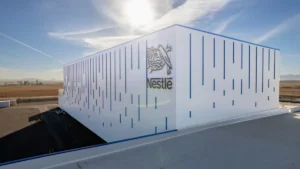 Nestlé USA has officially unveiled its new 700,000-square-foot distribution hub in Arvin, California. Equipped with a $330 million price tag, the state-of-the-art facility represents a critical step in the company’s broader $25 billion U.S. infrastructure upgrade, emphasizing a pivot toward leaner, automation-first supply chain workflows. The Arvin facility houses the largest Automated Storage and Retrieval System (ASRS) in Nestlé’s global network, operating alongside laser-guided vehicles, automated crane systems, and layer-picking robotics. This build marks a major shift from retrofitting existing spaces to intentionally designing high-tech capabilities directly into greenfield logistics layouts from day one. Designed to mitigate peak-season labor bottlenecks, upskill the frontline workforce, and run on 100% renewable electricity as a zero-waste site, the facility showcases how global leaders are leveraging heavy automation to establish flexible, resilient distribution networks that protect margins against ongoing labor and capacity constraints.
Air Freight Spot Rates Spike 41% YoY in May, but Relief Is Expected Soon
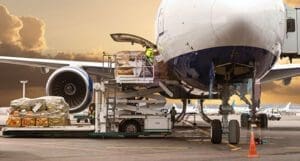 Global air cargo spot rates surged by 41% year-over-year in May, averaging $3.40 per kilogram, driven by persistent geopolitical disruptions, carrier fuel surcharges, and localized demand booms like semiconductor and data center equipment shipments. According to Xeneta data, spot rates from Northeast and Southeast Asia to North America jumped nearly 40% compared to earlier this year. However, the pricing pressure isn’t uniform; transatlantic lanes from Europe to North America actually saw a 26% decline over the same period. For procurement teams battling these elevated costs, there is a glimmer of light on the horizon. Long-term contract rates appear to have peaked in April, and as carriers restore capacity and the market enters its traditional summer lull, analysts predict that year-over-year spot rate comparisons will finally begin to cool down, offering much-needed breathing room for shippers who have been relying on short-term contract extensions.
Song of the week:
AI Is Reshaping Supply Chain Execution. Here’s What Comes Next.
Two ARC Advisory Group white papers on the next stage of AI in supply chain operations.
AI is moving beyond isolated copilots and technical architecture into coordinated operational decision systems. This ARC Advisory Group white paper explains how supply chain AI is shifting from capability to execution, where context, governance, workflows, thresholds, and action pathways determine whether AI improves real decisions across planning, logistics, sourcing, fulfillment, and risk management.
Download Our Featured White Paper:
AI in the Supply Chain Part II: From Architecture to Execution - Defining the Decision Intelligence Layer in Modern Supply Chain
Download Our Foundational White Paper:
AI in the Supply Chain: Architecting the Future of Logistics with A2A, MCP, and Graph-Enhanced Reasoning
Explore Our Domains
Planning, Execution & Visibility | Transportation & Logistics Operations | Warehousing, Fulfillment & Automation | Global Trade & Compliance | AI & Advanced Analytics | Data, Integration & Interoperability | Supply Chain Platforms | Risk & Resilience | Sustainability & ESG
Independent ARC research for supply chain leaders and technology decision-makers.