














From Deluges to Dry Beds: How Extreme Weather is Rewriting Logistics Strategy

 Historically, supply chain managers viewed extreme weather as a series of isolated, unlinked headaches, a temporary detour here, a delayed container vessel there. But recent events are proving that climate-driven disruptions are no longer isolated events; they are systemic, compounding risks occurring simultaneously. Right now, global logistics are caught in a bizarre paradox of water volatility: inland waterways are concurrently shutting down due to both catastrophic flooding and severe drought.
The Current Snapshot:
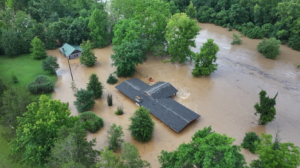
In the United States, flash flooding across Missouri and the wider Ohio and Tennessee river valleys has completely knocked out regional road networks, forced emergency evacuations, and pushed the Black River to a projected record crest of 28 feet. Thunderstorms piled on top of each other to dump between 6 and 12 inches of rain across southern Missouri, with some areas near Miaoli receiving nearly 31 inches (80 cm) of downpour. The deluge tore a woman’s home entirely from its foundation, claiming her life, while the Army National Guard had to deploy Black Hawk helicopters to rescue more than 200 children and staff trapped at a summer camp in Lesterville. These slow-moving storms have brought regional last-mile and freight networks to a halt.
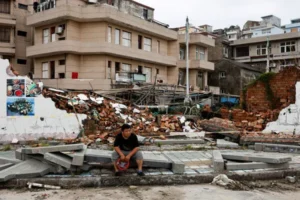 Across the Pacific, Typhoon Bavi just battered Taiwan and East China, forcing massive evacuations of over 2 million people and completely disrupting cargo handling and air freight at major hubs like Shanghai, where airlines canceled more than 680 flights. Yet, while parts of the world are drowning, Europe’s most critical commercial artery is choked by a severe mid-summer heatwave. On July 13th, water levels at the critical Kaub chokepoint on the Rhine plummeted to 53cm, well below the 81cm threshold where standard low-water surcharges apply. Freight barges are currently restricted to carrying just 20% of their total capacity, forcing operators to move volumes by individual agreement only. This near-standstill has triggered a massive, expensive migration of freight onto an already maxed-out rail and road infrastructure.
The Strategic Shift: Redundancy is Dead, Dynamic Flex is In
 This dual reality underscores a massive trend shaping supply chain management: the shift from static risk planning to dynamic execution. When a primary inland waterway fails, you cannot simply rely on a fixed backup plan, because your backup mode (whether it is rail hubs restricted by local congestion or trucking lanes blocked by flash floods) is likely facing its own climate or operational constraints.
To endure this era of unforeseen climate events, logistics leaders are focusing on three main areas:
- Mode Elasticity: Building contractual agility into carrier agreements so that switching from barge to rail, or air to ocean, can happen in hours rather than weeks.
- Predictive Visibility Beyond Tier 1: Moving past simple track-and-trace. True resilience requires mapping out how weather events three states over will impact infrastructure, labor availability, and warehouse productivity downstream.
- Climate as a Network Design Parameter: Historically, networks were designed almost purely around labor costs, tax incentives, and transit times. Network optimization models must now ingest historical climate data and predictive models as core constraints when choosing warehouse locations and routing strategies.
As the current El Niño cycle threatens to further scramble global rainfall and temperature patterns, the old playbook of waiting out the storm is officially obsolete. Volatility is the new baseline, and the competitive advantage belongs to the networks built to flex.
AI Is Reshaping Supply Chain Execution. Here’s What Comes Next.
Two ARC Advisory Group white papers on the next stage of AI in supply chain operations.
AI is moving beyond isolated copilots and technical architecture into coordinated operational decision systems. This ARC Advisory Group white paper explains how supply chain AI is shifting from capability to execution, where context, governance, workflows, thresholds, and action pathways determine whether AI improves real decisions across planning, logistics, sourcing, fulfillment, and risk management.
Download Our Featured White Paper:
AI in the Supply Chain Part II: From Architecture to Execution - Defining the Decision Intelligence Layer in Modern Supply Chain
Download Our Foundational White Paper:
AI in the Supply Chain: Architecting the Future of Logistics with A2A, MCP, and Graph-Enhanced Reasoning
Explore Our Domains
Planning, Execution & Visibility | Transportation & Logistics Operations | Warehousing, Fulfillment & Automation | Global Trade & Compliance | AI & Advanced Analytics | Data, Integration & Interoperability | Supply Chain Platforms | Risk & Resilience | Sustainability & ESG
Independent ARC research for supply chain leaders and technology decision-makers.