














 Note: Today’s post is part of our “Editor’s Choice” series where we highlight recent posts published by our sponsors that provide supply chain insights and advice. This article comes from GlobalTranz and identifies what shippers and carriers need to know about the FMCSA HOS final rule.
On June 1, 2020, the Federal Motor Carrier Safety Administration (FMCSA) revised the hours of service (HOS) regulations for motor carriers. The rule will go into effect on September 29th, 2020.
The FMCSA HOS final rule is intended to provide drivers flexibility while promoting safety for drivers on the road. As shippers contend with rising freight rates and managing heightened shipment volumes, while at the same time preparing for retail peak season, understanding the potential impact of the new ruling on truckload capacity is critical to success now and through the end of 2020.
In a recent video, U.S. Secretary of Transportation Elaine Chao said the FMCSA HOS final rule would “help drivers reach their destination safely without feeling like they’ve got to race against the clock to comply with federal mandates. They will also help truckers get the rest they need when they need it.”
The FMCSA revision to four HOS provisions was based on feedback from industry safety advocacy groups, the U.S. Congress, and the American public. The FMCSA noted that in addition to providing drivers more flexibility and promoting safe driving habits, the HOS final rule is estimated to provide nearly $274MM in annualized cost savings for the U.S. economy and consumers by reducing costs for motor carriers.
Click HERE to read the rest of the article which highlights four main revisions.
 I turned to Jon Sampson to explain these regulations to me. Mr. Sampson is the Executive Director, Agricultural and Food Transporters Conference (AFTC), of the
  Cubs win! Cub win! And for the first time in the 100 years the Cubs have been playing at Wrigley Field, they clinched a post-season series at home. As Jason Stark pointed out, this was the 7,907th game played at Wrigley – and they finally clinched a series at home. This series also marked the first time since 2003 that the Cubs have won a post-season series at all. As a life-long Red Sox fan, I understand the pain of Cubs fans, and the elation they are feeling now. I remember the 2003 post-season clearly, when it looked as though the Sox and Cubs were destined to meet in the World Series, guaranteeing that one curse or the other would end. The only thing that ended was the hopes and dreams of the Sox and Cubs fans when both lost the Championship Series in devastating fashion in 7 games. The Sox got their revenge the next year with a post-season run for the ages. And even now, after 3 last place finishes in 4 years (of course that 4th year was another World Series win), I can’t really complain too much about the Sox. But I think most of us in Boston are jumping on the Cubs bandwagon, and hoping they bring the World Series trophy to Chicago.
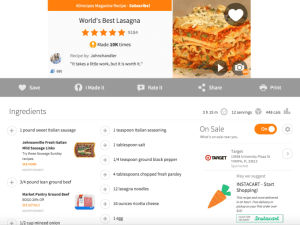 Instacart and Allrecipes have partnered to allow home cooks to add a meal’s ingredients to their grocery list with a click of a button. This move pushes Instacart into unchartered waters – ingredient delivery service. Players like Blue Apron and Hello Fresh have become more popular as customers have a box of ingredients with recipes delivered to their door. While these services are a bit on the expensive side, the Instacart – Allrecipes partnership will appeal to more price-conscious shoppers. And given Allrecipe’s reach – 1.3 billion visit a year – this is a huge growth opportunity for Instacart.
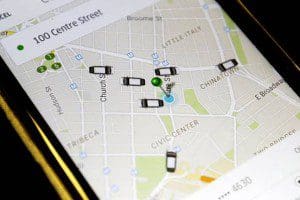 Uber is expanding its UberRush service to Chicago and San Francisco. The service, which has been tested in New York for the last year, is a smartphone enabled courier service. Instead of hailing a ride around town, customers can order a pizza to be delivered. UberRush allows merchants to plug a customer’s order into an online order form. At that point, a courier (on foot, bike, or car) will pick up the order and deliver it to the customer. Uber collects a $5 to $7 delivery fee, which is either passed on to the customer or paid by the merchant. In its expansion, Uber is building what chief executive Travis Kalanick has called an “urban logistics network.” The network includes Uber, UberRush, and UberEats, which was launched last fall to lunch and dinner items from popular restaurants to Uber users in parts of New York City, Chicago, Los Angeles, Toronto, and Barcelona.
 UPS announced that it is expanding its UPS Worldwide Express Service by adding 41,000 additional global postal codes. This service provides customers with guaranteed delivery on the next possible business day by 10:30 a.m., 12 noon, or 2 p.m., based on destination. The company says this will result in earlier guaranteed-delivery options for shippers that only previously had end-of-day guarantees. The service will now be available in 65 countries that make up 91 percent of global GDP, with the bulk of the new codes in the Asia Pacific region. It is the single largest one-time expansion of the service ever.
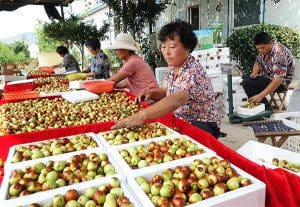 Chinese search engine giant Baidu is entering the e-commerce fresh produce sector. The company is investing $20 million (10% of the latest $200 million in funding) into Womai, a food website owned by China National Cereals, Oils and Foodstuffs Corp (COFCO), a leading supplier of agricultural products. The investment comes as a growing number of Chinese consumers are turning to the Web for fresh produce. The funds will be used to increase the cold-chain logistics infrastructure and for third-party delivery systems.